
Today I went on another of those "great, all-morning voyages" of discovery through the internet. Via Jonathan Blow's blog, I found his and Chris Hecker's "New Year's Resolutions for Game Industry Newbies," which quite rightly suggests that anyone aiming to break into the games industry actually get up and make something great, which no amount of chatting with developers or reading industry news can make up for.
Elsewhere on Hecker's site I found his transcript of the original print ad for Electronic Arts, presumably from 1983 or '84. It seems sadly ironic now, more than 20 years later, to think of such noble (and still relevant) aspirations leading to the advent of more than a dozen Need for Speed sequels, the EAspouse debacle, and "one to three feature innovations per title."
I found a strangely moving elegy to the end of Bob Barker's tenure on The Price is Right through, embarrassingly enough, googling my own URL (the writer references "Evelyn" in a post about photography of the dead and dying.)
Finally, via GameSetWatch's most recent microlink roundup, I found SexyVideogameland, the blog of Leigh Alexander. In one of her posts, she profiles an extremely surreal and fascinating Japanese point-and-click flash game called "Guest House," which is worth playing through for its stifling atmosphere and wonderfully realized expression of dream logic (though I'll admit I had to look up a walkthrough to find the stupid coin hidden on top of one of the breaker boxes.)
The post linked from GameSetWatch contains scans and transcripts of Alexander's childhood Phantasy Star II fanfiction, hand-bound with a stapler and lovingly illustrated in glorious colored marker. It reminded me of all the reams of paper I'd filled with video game drawings as a kid, hand-bound with a stapler and illustrated in glorious colored pencil, a few of which I've held onto over the years. My earliest writings were illustrated stories based on Mike Tyson's Punch Out!!, which I was fairly obsessed with at five years old. Then I moved on to drawing my own versions of Contra, Double Dragon, and the TMNT arcade game, including pages of ideas for new weapons and levels. It's funny to think that it took me til halfway through college to realize I wanted to be a video game designer.
The final stop of my journey through the internet today was this piece of critical advice for bloggers, via Duncan's Hit Self-Destruct. It certainly describes my mindset for the first year of Fullbright, where I didn't even have comments enabled or a hit tracker installed. A lot has changed since then, and it's a credo that I need to always keep in mind going forward.
1.06.2008
Resolutions


12.19.2007
Yuletide
Thanks again to Simon Carless for posting a slightly-altered version of this article on GameSetWatch.
My blog's been getting pretty serious lately. I want to do some frivolity. So, considering the season, I present my list of "Best Games Set During Christmas." This isn't a numbered countdown or a definitive round-up but simply a little compilation of the best games I can think of that have Christmas settings.
Snatcher - Hideo Kojima's 16-bit adventure game was developed during that long gap between Metal Gear 2 and Solid, and released in the west on Sega CD. Its gameplay is staunchly point-and-click in the Sierra or Lucasarts tradition, with a little bit of Hogan's Alley thrown in every once in a while. The game is a transparent "homage" to Blade Runner, mixed with some Invasion of the Body Snatchers and a cornball anime veneer to top it all off. It takes place in Neo Kobe after a catastrophic man-made disaster wiped out much of the world's population. Expats trapped in Japan turned Neo Kobe into a strange dystopian melting pot, and it's here that one Gillian Seed, blade runner junker agent extraordinaire and classic amnesiac video game protagonist carries out his mission of hunting down replicants bioroids that have gone rogue. It's also set during Christmas time, featuring decorations and holiday ads throughout the city, as well as Gillian's informant, Napoleon, who dresses up as a shopping mall Santa to hide in plain sight.
Skip to 6:15 for hot Santa informant action:
Bully - Rockstar's reform school saga depicts a year in the life of Jimmy Hopkins, a wayward kid trying to thrive in the dog-eat-dog social maze of Bullworth Academy. The game takes place during fall, winter, spring, and an "endless summer," beautifully realizing each season in turn. On Christmas day, Jimmy is called to the principal's office to receive a gift that his mother has sent him: a hilariously goofy reindeer sweater, which he's compelled to wear back to the dorms, being laughed at and scorned by his classmates the entire way. Really funny stuff.
Boogie Wings/The Great Ragtime Show - Data East released one crazy side-scrolling shooter back in '92, which tried all sorts of wild mechanics and paired them with a bizarre ragtime theme. In the game, the player pilots a Red Baron-esque biplane and flies left-to-right blowing up soldiers, tanks, cowboys, mobsters, and anything else unlucky enough to get in his way.
A couple things make the game unique: one is the free-swinging tow line that hangs from the plane, which the player can use to hook enemies and objects in the world, and fling them about at will. You can pick up tanks or bombs, then whirl the plane around in a circle to whip them at the opposition, causing a huge chain reaction of destruction. Or, you can sadistically pick up a poor unlucky soldier and send him sailing through the air for your own amusement. Another interesting aspect is that the player can hop out of the plane and run along the ground, or jump into jeeps, tanks, and other vehicles for a change of pace.
The game lets the player choose from five different themed levels, one of which is titled "Merry Merry Christmas." In it, the player flies through a city fully decked out for the holidays, shooting up Christmas trees, snowmen, and tossing mall Santas about with his tow line hook. At the end of the level, the player fights an enormous mechanical Santa who tosses crates at you from his sack of presents, and trades his Salvation Army hand bell for a flintlock pistol, all the while shouting out "MERRY CHRISTMAS," as if to taunt you. Either that or he's just having a really good time. Check out the video below for a midi-styled ragtime interpretation of "Joy to the World."
Hitman Blood Money - I'm a huge fan of the Hitman games, especially Blood Money, which took the series formula and executed it to absolute perfection. In one level, Agent 47 is sent to assassinate a wealthy pornography mogul and his playboy of a son, who have become political liabilities to a certain individual who has called upon your services. To do so, 47 drops in on the pornographer's "Christmas in July" celebration at his snowy cliffside abode in the mountains of Colorado, complete with a festive tree, Christmas lights, presents, and red latex outfits for the ladies in attendance. So, stalk the drunken Santa Claus into a nice secluded alcove, dispose of him quietly, steal his clothes, and enjoy our favorite chrome-domed assassin decked out as old Saint Nick. If there's one thing the Hitman series has always had, it's a strong undercurrent of dark humor.
Animal Crossing - Another game that takes place during every season, the month of December is especially cheery in the little town that lives inside your GameCube (or now, Wii.) Animals will graciously trade Christmas presents with the player, Nookington's features Christmas trees (and menorahs) all month long, snowmen start to pop up (and talk!), and blinking, festive lights cover all the trees in town. On Christmas eve, Jingle the red-suited reindeer will reward you with holiday-themed furniture if you can track him down as he makes his rounds.
Raw Danger! - I was recently turned on to Raw Danger! by the GameSetWatch rundown of "2007's Top 5 Overlooked Games." I picked it up, I've been playing it, and I love it. It's got no production values: it looks almost like a PS1 game, the translation is bad, and the voicework is even worse. But the actual design of the game-- the things you can do and the way you do them-- is outstandingly unique, fascinating and fun. It's an action adventure game that aims to provide tension, excitement, and a sense of "raw danger" without any sort of combat or hostile creatures whatsoever. The game's central dilemma is one of the rarest in games, Man versus Nature, and the designers find ways to engage the player simply through direct conflict with the environment itself, as you try to survive in a world that's crumbling around you.
The depth of character management is impressive: you gather items, juggle an inventory and equip new clothes and accessories to stave off hypothermia during the game's ongoing torrential flood, as well as pushing your relationship with various side characters this way and that via a wide range of dialogue options. The game even manages to be player-friendly and opposes the frustration factor by invisibly placing checkpoints before any spot where you're likely to be killed by some sort of sudden collapse or perilous situation.
The game is notable for being an extremely lo-fi production that commits itself to trying something out of the ordinary by engaging the player with other than shooting or swordplay, or even acrobatics and colorful platforming. The game's excitement and tension come from navigating a world that could come tumbling down at any minute, and figuring out how exactly you're going to get yourself out of the seemingly hopeless situation brought on by the disaster at hand. The narrative, though clumsily told, is intriguing for its structure: you play as up to six different characters in turn over the course of the game, and your actions as one character might impact, or even doom, another playable character down the line. To meet up with a female convict in the first character's story, then play that encounter from the convict's point of view during the second scenario is just super cool, and makes you reflect on your decision-making throughout the game, knowing it may come back to you in the end.
Anyway! The game is set during three long, arduous days, starting on Christmas eve 2010. The season comes into play as your first character is a waiter at a Christmas gala unveiling the new superdense underground metropolis, "Geo City." Vestiges of the season can help or hinder your progress, as at one point the player shimmies along a string of Christmas lights hanging above a raging torrent, and at another point an enormous shopping center Christmas tree can topple over and crush you if you're not careful. See the trailer below for hilarious comic timing, set off by the initial strings of "Jingle Bells."
So, if you need help getting in the spirit, try out something from this list! Now would be a particularly good time to start up a town in Animal Crossing, or to support the team at Irem who went out on a limb to bring us Raw Danger! Happy holidays!
12.15.2007
Clarification
As a companion piece to my post "Dead Men" below, my friend Chris published a different article of mine singing the praises of Kane & Lynch over on the Shacknews blog. My post "Noir"was also graciously linked by Simon Carless on Gamasutra's blog, GameSetWatch. I'd like to extend my gratitude to them both for spreading my words around.
I think that my heavy evangelism of Kane & Lynch, along with my posting of "Dead Men" immediately after "Noir," and finally relating that game to the "noir mindset," may have given off a bit of a false impression, though. While I do think that K&L is admirable for affecting some of noir's most compelling narrative approaches, it's not "THE GAME" that epitomizes that theoretical overall production I outlined in "Noir." "Noir" described a game that, to my knowledge, does not exactly exist at present. There are a few reasons that Kane & Lynch isn't that game.
1) Scale of production: Kane & Lynch is a full-scale commercial production that aims for "triple A" status. It includes a full singleplayer/co-op campaign as well as a separate, full-featured competitive multiplayer game mode. It uses a graphics engine that has been updated to current-gen standards which, while not on par with the cutting edge of Unreal 3 tech, attempts to wield all the visual bells and whistles of its contemporaries. It was released across three current-gen platforms, and boasted a fairly massive intercontinental advertising campaign. Perhaps to its detriment, Kane & Lynch was a "big game" in every applicable respect. Conversely, a noir game will fully embrace a narrower production scope, intentionally modest level of graphical fidelity, and low-intensity approach to marketing/distribution.
2) Scale of Conflict: While the personal conflicts that drive Kane's character arc are compelling, and the narrative itself largely maintains a direct, visceral and human scale, the physical conflict acted out by the player is a different thing entirely, maintaining the status quo of mowing down hundreds of faceless enemies over the course of a video game. The noir approach does not embrace the flood of cannon fodder common to contemporary action titles, but instead promises an experience buoyed by its characters' internal conflicts, and only punctuated by sudden outbursts of violence that are meaningful to the player's understanding of the gameworld. Noir and Rambo do not mix; the handful of deaths in Kane & Lynch that do truly matter are diluted by the dozens upon dozens in between that are completely meaningless. Interestingly enough, the one of the only action games that makes a genuinely compelling experience out of killing as few people as possible also comes from Io Interactive: the Hitman series.
So, I'll apologize if my message with "Noir" and "Dead Men" seemed to be, "here is a description of the noir approach, and here is a perfect example of that approach made reality." Not quite: as a story and character study, Kane & Lynch is as successful an attempt as almost any action game you might compare it to, and owes much to the noir mindset; as a game however, while executed well for what it is, doesn't attempt to alter the paradigm of the traditional big budget, wide-release, AAA shooter production.
But halfway there is a good start.
12.07.2007
Dead Men
Thanks to Chris at Shacknews for publishing a sister piece to this article.
There are already games that pull from noir in story, characterization and tone. One was released just weeks ago, and I'd go so far as to say that it constitutes a "modern noir," in the same way you might classify Chinatown, Blade Runner, LA Confidential or Brick as such. It's a crime tale, a story of one man's futile attempts to atone for his past and reconnect with his family, and a modest production that doesn't overstay its welcome or try to out-epic Epic. It's Kane & Lynch: Dead Men, an unpolished gem to be sure, and one that hasn't connected with the popular reviewership. It's extraordinary for reasons that don't necessarily equate to a high numerical score, but it deserves better than this. Kane & Lynch eschews what usually appeals to the public's adolescent "cool" factor: the protagonists aren't the usual posable action figures with huge muscles, bulky body armor, or the latest high-tech equipment. They're two grisled, middle-aged men, over the hill for mercenary work, both balding, world-weary, clad in muted suit and tie. The story takes place in alleys, diners, and city streets; in metropolitan banks, prison blocks, dance clubs and corporate towers; finally, in the Cuban capitol under siege and a mercenary camp in the jungles of South America. The guns are simple pistols, rifles, and shotguns that might be found in a pawn shop or at a common shooting range. The game focuses on the criminal underworld, and what happens when these elements show themselves on the surface of society. There is simply nothing fantastical about it--think of how rare that is in action games today--and the effect is all the more powerful for it.
The following section discusses the game in a way that includes full plot spoilers. (Scroll down to the next bolded marker to skip spoiler section.)
The flawed protagonist, mundane settings, and tragic arc of the story are what make it a modern noir. The game casts the player as Adam Marcus AKA "Kane," an old-school mercenary criminal who, as the story begins, has fucked up for what he thinks is his last time. His most recent job with his long-time criminal syndicate, "The 7," went wrong, leaving 25 civilians and (he thought) the rest of The 7 dead, with only Kane left to take the blame. He took the money and ran, leaving it with a business associate before being picked up by the police. Now he's on his way to the gas chamber. In the prison transport van, Kane carries with him a letter he's written to his estranged daughter Jenny. He abandoned Jenny and her mother 14 years earlier to pursue (protect them from?) his life of crime, and his letter expresses all the regret he's bottled in since then. But halfway to death row he's busted out by agents of The 7, who it turns out didn't die in Venezuela after all, and are a little irked that Kane ran off with the loot from the failed heist before being apprehended. So, they've kidnapped that estranged family of his and give him three days to bring back their score. They call him a traitor, saying he double-crossed them to run with the cash; if he doesn't bring them what they want before time runs out, his family is going to die. In Kane's tow they send along Lynch, a fellow death row inmate they've hired to keep an eye on Kane during the job, while The 7 stays safely in hiding.
 The rest of the story portrays one man's attempts to right all his past wrongs, a road paved with good intentions but ending up in hell despite it all. Kane is trying to "fix everything": to prove he's not a traitor as The 7 say, and to fish his family back out of the fire; most of all, to express to his daughter Jenny all the regret he's felt over abandoning her so long ago. Each mission in the game illustrates another attempt at redemption being stopped in its tracks for one reason or another. Kane tries to simply retrieve The 7's loot like they ask, but finds that it's been swiped before he could get to it; he tries to bargain with the mysterious figure who's stolen the loot by (ironically enough) kidnapping that man's daughter, only to have the extremely unstable Lynch kill the hostage at the last moment, completely screwing the pooch. When Kane misses the deadline and The 7 goes through with their threats to execute him and his family, he manages to free himself and Jenny, but not before The 7 kill his wife right in front of his daughter's eyes. Jenny escapes, only to later be tracked down and apprehended by The 7, held hostage to keep Kane under their thumb.
 The game takes a turn toward revenge tale as Kane chases the rest of The 7 all over the globe, now out for payback against each one of them, and moreover to free his daughter from their grasp once and for all. To aid in his search, Kane busts his old crew of underworld buddies out of maximum security prison, promising them a new lease on life and a cut of the action if they help him out. Though he does manage to exact revenge on one member of The 7 after another and to finally secure Jenny in a daring airstrip raid, most of his old crewmembers also fall to gunfire one by one along the way, leaving the player to wonder whether they wouldn't have been better off back in prison.
The climactic scene of the game finds Kane at a crossroads: he has Jenny as well as a chopper to escape with, but the remaining members of his crew are holed up under heavy enemy fire in a nearby church. Does he take Jenny and run, leaving his men to die and proving himself to be the traitor they've all accused him of being, or does he do the honorable thing and risk Jenny's life to save the men that are counting on him? The player gets to choose, and there's no making it out clean regardless: if you grab the chopper and run, you've damned Kane to live up to the expectations of all those around him, to prove himself a man without honor. Kane's saved his daughter's life but done nothing to win her heart. It's an empty victory.
If the player chooses the other path, and attempts to prove that Kane isn't a traitor, all of his men die in the ensuing firefight regardless of his best efforts. Likewise, Jenny catches a stray bullet, and must finally be carried to the small escape boat that Kane and Lynch commandeer at the far end of a lonely dock. In the final cinematic, Jenny succumbs to her wounds as she lies in Kane's arms. He reads her that letter he was writing at the outset, the one that explains all his regrets, the one he never got to send. She doesn't hear a word of it. The boat drifts out to sea.
Spoilers end here.
This isn't a video game story, and these aren't video game characters! This is The Asphalt Jungle, or The Killing. Kane is the flawed and disaffected Sterling Hayden character, the weathered underworld soldier bringing his old crew back into the fold to pull off that one last retirement job. He's dragged down by his own shortcomings, and brings everyone around him down with him. The end of the story isn't triumphant or life-affirming: it's the protagonist face-down in the dirt of his family's old horse farm; it's the cash fluttering away on the tarmac and the police detectives closing in. It's a pathetic skiff crewed by two defeated old men floating off into the sea, instead of a space marine in green armor saving the universe. It's a game that explores a group of completely damaged individuals, and doesn't cop out on giving them what they deserve so the player can feel good about himself. It's unflinching and morally bankrupt. It's noir. The game hasn't fared well with the critics, which I mainly attribute to a significant lack of polish present in the title overall. From playing it, Kane & Lynch is clearly a game that should have shipped four or six months later than it did, but was rushed out for the Christmas buying frenzy. Notable is that almost all of the reviews, even ones attributed to "Kane & Lynch PC," seem to come from Xbox playthroughs of the game. The movement, aiming and shooting mechanics are perfectly suited to the mouse and keyboard, but don't seem to have been retooled appropriately for a console controller. On a gamepad, the default aiming sensitivity is useless, and even after tweaking the settings, the aiming just doesn't work well on the consoles: the kickback of the guns is too extreme to deal with using an analog stick, and the levels aren't designed to accommodate the slower target acquisition and lack of accuracy with a controller as opposed to a mouse & keyboard setup. On top of that, across both platforms aspects of the presentation, especially scripted and prerendered cinematics, are rough at best; sadly, the endgame cinematics, while holding the most emotional weight, were given hardly any attention in execution, and come off flat despite their intended message being powerful.
In all, if you play Kane & Lynch on PC, it's an outstanding third-person squad shooter that I wholeheartedly recommend: using the simple cover system, squad commands, and visceral firearms to methodically cut a swath through your opposition is extremely satisfying, while the intense and affecting story keeps you riveted from moment to moment. That said, it's only the core experience that's so excellent-- a lack of time to apply all the necessary surface polish is readily apparent, and there are certain combat encounters that seem unbalanced compared to the rest of the game. And unless you're supremely patient, or supremely skilled at console shooters, skip the Xbox version. In my opinion, the PC version's positives completely outweigh the negatives, and it's one of the worthiest PC shooter purchases of the last year. But what really sets the game apart is its commitment to deliver a story that we don't get anywhere else in games, to devote itself to the noir mindset, no compromises, and show us one way that games can communicate something that's not juvenile, trite, or outright embarassing like most game narratives. If the development team had been allowed enough time to polish the game to the level it really deserved--and Hitman Blood Money showed that Io is capable of that level of polish--this unique experience could have reached more people. What could have been.
 Maybe Kane & Lynch is the kind of game story that never could have connected with the mass audience. But the beauty of games is that subversive property, the ability to distract the player with such an entertaining pure gameplay experience that they'll accept whatever narrative messages you want to send them. If the game's mechanics and dynamics had been properly tuned and balanced for consoles, Gerstmann might have relegated his incessant harping on the "impossible to care about" characters to a minor quibble, and given it a score that didn't relegate the game (or his career, natch,) to bargain bin status. In its current state, if you like PC shooters, yearn for video games that say something different, and love underworld noirs like Kiss Me Deadly, The Killing, or The Asphalt Jungle, you owe it to yourself to give Kane & Lynch a little of your time. For the people it manages to touch, it won't be easily forgotten.
12.02.2007
Noir
Thanks to Simon Carless for graciously posting about "Noir" on GameSetWatch, and re-publishing the essay as an article on Gamasutra.com
In the late 30's through the 50's, American film was a spectacle-based business. The market was dominated by the studio system, and blockbuster epics and musicals ruled the public consciousness. The stars, budgets, and sets were enormous. It didn't take long for the entire enterprise to become very bloated. Eventually, pricetags began outstripping profits in an arms race to sensory overload. It was during this era that film noir was born. Film noir was a pragmatic school of filmmaking, rebelling against popular big-budget fluff out of pure necessity. These were B-films, low investment projects quick to produce and intended simply to fill out an evening's double bill. Under the constraints of little money or time to build unique sets to shoot on, or to stage scenes featuring armies of extras, or to exploit complex lighting, camera setups, or special effects, noir filmmakers had to seek out new ways to build tension onscreen and keep their audience engaged. They did so by focusing on flawed, unpredictable characters living out street-level conflicts between individuals in the mundane, modern-day urban world. They drew from pulp novels and crime fiction for their source material, and benefited immeasurably from the influx of expatriate German Expressionist filmmakers fleeing the Nazi expansion throughout Europe at the time. Instead of building a fantastical set, film noir would film in vérité city streets and back alleys. Instead of dousing dozens of dancers with massive lighting rigs and filming them with a drove of whirling camera cranes, noir filmmakers would frame individuals frankly in dramatic up-shot, a single spotlight casting ominous silhouettes across the ceiling.
 Film noirs like Out of the Past, Kiss Me Deadly, and The Big Combo made a new kind of entertainment out of the very limitations that constrained them, and went on to influence everything from the writers of Cahiers du Cinema and the French New Wave of the 60's, to the Coen brothers' films of today. Necessity being the mother of invention, film noir created something unique and affecting, something that has lived on, out of the need to engage people without relying on the spectacle of the day's million-dollar blockbusters.
Maybe you can see where I'm going with this. We are currently a hit-driven industry, and the games that get media and player attention are those with the most money behind them to provide the biggest spectacle. In the commercial sector, everyone is vying with the likes of Mass Effect, Bioshock, and Halo 3 for mindspace; if you want to be taken seriously by "the gamer public," you have to hit not just the game design mark, but the whizz-bang cutting-edge graphical mark as well. You have to bring millions of dollars to the table just to qualify, which leads to extreme risk aversion by publishers and developers, and a tendency over time to lose players who are tired of the same old thing dressed up in more and more expensive clothes. When your game is backed by tens of millions of dollars, you can't use it as a testing ground for wild new mechanics and dynamics never tried before; however, when you're building a low-budget 2D platformer, even your successful experiments won't make an impact on the medium at large, the "big games" that get everyone talking. What we've got left is a huge gulf between popular, full-experience 3D action/adventure games that need to be financial blockbusters to survive, and marginalized casual/handheld/movie licensed games that don't register on the mass consciousness radar. We need our B films. We need that freedom to explore truly meaningful new avenues of interaction, quickly and nimbly, without the pressure of an eight-figure budget and multi-year dev schedule weighing down on the whole enterprise. Noir already scouted this territory for us.
 Noir begs game developers to reign in the scope of their production budgets, and the conflicts they depict. The noir approach promises games wherein the player isn't saving the kingdom, world or galaxy; wherein the ubermensch doesn't mow down a thousand men; wherein we can experience familiar settings in a new way, and infuse the everyday with the extraordinary. The noir approach promises games that are direct, visceral, and intentionally oppose epicness-- games that deliver their entire message with immediacy, before you lose sight of how the story of their interactions began.
 Games that take film noir as a cue shouldn't emulate the surface-- trench coats, cigarettes, femme fatales and old LA. Games should emulate the structural and emotional underpinnings that made noir work as an experience. We can do this with readily-available, inexpensive tech; we can leverage older 3D engines and simpler lighting & shader models in the same way noir filmmakers used location shooting and expressionistic cinematography. We already have our Gone with the Winds and Wizards of Oz, and a dozen Busby Berkley spectaculars to fill in the gaps; we need our Asphalt Jungles, our Kiss Me Deadlies, our Gun Crazies and Double Indemnities and Out of the Pasts. We've proven we can do big. Noir shows us how to take the small road, explore its every twist and turn, and connect with our audience in new ways.
11.27.2007
Soldier
I read a quote last night in The Cage by Kenzo Kitakata:
"What good is a soldier who doesn't want a medal?"
11.12.2007
Length
A straightforward post today: the games I play are just too long.
I'm currently playing The Witcher, which is a pretty great game-- a solid PC RPG with a unique tone-- but I've probably put 15 or 20 hours into it, and I find myself wishing it were over. Not because I'm not enjoying it, but because I feel like I "get it"-- I've seen what the game has to offer, I've played through the available breadth of interactions, and now I'm simply repeating the established inputs in slightly different contexts. Maybe I'm casting a more powerful spell at a new enemy, but it's only a surface difference from the same dynamic found in the first hour of the game; maybe I'm navigating a new dialogue tree with a new character, but only the words are different while the interaction is the same. The prologue and first chapter of The Witcher were so fresh, fun, engaging, and perfectly cohesive as a unit, that I wish the first six hours had been the entire game, and left it at that. At the rate I'm going, I don't know if I'll see the ending at all.
I have a novelty-seeking personality, and always want to consume as many different films as I can, play through as many different games as possible, listen to a new album, fully digest it, then move on to the next. I'm not an MMO devotee, and I don't usually replay games I've already completed. But even finishing single-player games in the first place isn't all that common, and I know I'm not alone. From what I've been told, according to market research, fewer than half the players of any given commercial game make it past the 50% point of the campaign, and the dropoff increases rapidly the further you go. So, fewer than 50% of players make it past the second island of GTA3, or past the Berserker in Gears of War, or past the castle in Resident Evil 4. And forget about actually seeing the end credits. So I ask you: if only half your players even make it halfway through your games, why aren't we making games that are half as long?
I think Portal demonstrates how much greater a game can be for matching its length to its content. Portal hit that perfect mark at which the player had learned all the available inputs and play techniques, been given just enough to master them all, and experienced a complete narrative arc by the moment the end credits roll. Portal was 4 hours long because it only needed to be 4 hours long, no more, and probably no less.
In the same way, how long does it take the player to fully absorb all the mechanics and artifice of, say, F.E.A.R.? After a few hours, you've got a handle on all the movement controls, the battle tactics, the slow-mo effects; you've become familiar with Alma, the replica soldiers, and the general tone and rhythm of the game. At what point do you transition from exploring a new set of experiences, to rotely going through the motions just to reach the ending? I believe that in most games the transition point comes well before the conclusion of the included content, and it's at this moment most people put down a game for good, forgoing half the game they paid for; I believe the research bears this out.
I want all games to be as tight and compact as Portal-- greater length should be reserved for games of greater depth. I want to absorb the atmosphere and full range of interaction a game has to offer, then reach a resolution before it all becomes stale. I don't like that my arc of interest in Rogue Galaxy, Rainbow 6 Vegas, Halo 3 and Persona 3 ended long before I completed their campaigns. I want to finish these things without having to trudge-- I want the six-hour game that I can enjoy and complete and make a clean break from instead of just giving up. A six-hour game is reasonable; I can burn through a six-hour game in a night if I'm really dedicated, or play an hour a night and actually finish it in a week instead of a month. I want an hour or two to get acquainted with the world, a couple more hours to master the techniques embedded in the game dynamics, and then a final hour or two to really revel in the depth of the systems and finally resolve all the narrative elements. I want this to be true of all the games I play: action, adventure, and RPG. Stop making me force myself to finish your games.
I want to see a structure like this: develop your core gameplay, refine all the systems, then create a full, cohesive, well-paced 6-hour campaign that expresses it all in a compact fashion, a campaign that can stand on its own, that follows a complete narrative arc and provides me a satisfying resolution. Put an entire game into the first island of GTA3, or the prologue and first chapter of The Witcher, or the first act of Half-Life 2, and release it at retail as the "base game." Let me take away that single experience if that's all I want. Then, release the remainder of the campaign in chunks-- "Extensions" if you will-- that add further hours of content onto the base experience. If I'm satisfied with just the base game, I've given you my money and don't feel cheated out of an ending; then, if I just can't live without more content, I'm free to extend the game by buying more chunks of content from you and adding it onto the end of the base campaign. Do I want the game to be six hours, or 16, or 26? That all depends on my level of engagement with the world you've created. But regardless of what it is, I don't want to feel like I've missed out on a resolution to the game's conundrums just because I didn't have the level of commitment required to slog through a dozen hours of filler. The GTA structure would be perfect for this kind of release-- the base game is the entire city with just the core story missions woven through it; further Extensions weave more missions and characters into the existing gameworld, or provide access to a new island. It's a gameworld that expands outward at the player's will.
Think of it: how often do you walk out on a film halfway through? I'd wager not as often as you buy or rent a game without ever finishing it. How is it not a red flag to the industry that the player rarely sees the ending of the game you've made for them? We need to open our eyes. Give me base games that I can finish comfortably, or extend if I so choose. Leave me wanting more, instead of feeling relieved when it's finally over.
11.08.2007
Retail
It's official: my first title as professional level designer has reached retail store shelves.

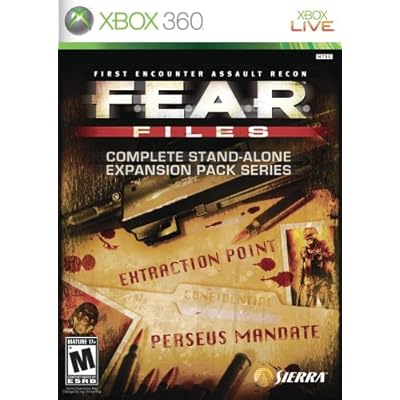
The low profile of the title means it hasn't received many reviews of yet; other factors have kept the reviewers from being too kind. Perseus Mandate is taking a bit of a beating, while F.E.A.R Files is doing a little better, no doubt bolstered by the added value of Extraction Point being included in the box. Innumerable factors result in the final state of a game at release, much less the review scores of that game, but I stand by my work on the title, and am proud to have been a part of something that I hope will bring some players a good deal of enjoyment during their time with it. As a fledgling designer, one who is only a single member of the design team and who was brought onboard less than 6 months before we went gold, I can only take some small amount of credit for our successes with the game, and a small amount of responsibility for our failings. I also hope that as more reviews trickle in, those Metacritic averages might creep upwards a bit.
We're digging in our heels and revving up pre-production for our next big, unannounced title. Here's hoping that with more resources of all kinds at our disposal, we'll be able to use the lessons learned from Perseus Mandate and deliver something truly outstanding!
In the meantime, if you do pick up Perseus Mandate or F.E.A.R. Files, pop open Instant Action: Sprint or Instant Action: Arena to play the two levels which are entirely my own, from concept to final polish. I am also largely responsible for Instant Action: Clinic, though I built it up from a base created by fellow level designer/former QA tester Ian Shepherd. My hand is visible throughout the campaign as well, though none of the level layouts or meta-elements are mine; only finishing and polishing. I'll have images and video of the material I'm directly responsible for sometime in the near future, for the curious.
Cheers!
11.05.2007
Muertos
The annual Dia de los Muertos processional was held last Friday in the Mission district of San Francisco. From the site:
The Day of the Dead is a unique festival that is the result of 16th century contact between Mesoamerica and Europe. Conceptually, it is a hybrid, owing its origins to both prehispanic Aztec philosophy and religion and medieval European ritual practice. Ceremonies held during the Aztec summer month of Miccailhuitontli were mainly focused on the celebration of the dead. These were held under the supernatural direction of the goddess Mictecacihuatl. Both children and dead ancestors were remembered and celebrated. It was also during this month that the Aztecs commemorated fallen warriors. According to Diego Duran, a 16th century Spanish priest, the Aztecs would bring offerings of food to altars in honor of the dead. They would also place small clay images that were supposed to represent the deceased on these same altars.
When the Spaniards arrived in the 16th century, they brought the Christian Holiday of All Soul's Day with them. This was a Roman Catholic holy day commemorating the dead in general as well as baptized Christians who were believed to be in purgatory. Spanish priests were quick to see a correlation between the Aztec and Christian celebrations so moved the Aztec festival from summer to fall so that it coincided with All Soul's day. This was done in the hopes that the Aztec holiday, which the Spaniards considered to be pagan, would be transformed into an acceptable Christian holiday.
The result of this cultural blending is an event where modern Mexicanos celebrate their ancestors during the first two days of November, rather than at the beginning of summer. While this modern festival has Christian components, it still maintains its indigenous Native American ones.
I love being back in the city. Attending these sorts of community events is like nothing else.


I only thought of Grim Fandango a couple times, honest :-)
10.29.2007
Gun
I was briefly very curious about GUN, the Neversoft game.
The original announcement of the game only revealed the title and an ominous tagline on a black background: "Pull the Trigger. GUN." And, to someone immersed in the video game dialogue, how provocative is that? Popular games, following the sea change caused by Wolfenstein and Doom, have been about the power and allure of the firearm. Firing guns at living targets encapsulates the two biggest psychological draws of video games: being able to do something you otherwise can't in the real world, and a sense of power and control over a chaotic situation. I expect most people who play shooter games haven't actually fired a gun in the real world, much less killed, or even badly injured, another person. It's unthinkable on some level, but on the other hand it has the appeal of the taboo-- I can't actually shoot someone... but what is it like? It's an experience that is familiar to the audience via film and television, but even then still only secondhand; games deliver the visceral sensation of actually doing. Games play out the audience's illicit love affair with the firearm. And not just America's, but Japan's and Europe's. A fascination with instant death.
 I've fired real guns. Admittedly, my motivation was game-related-- I'd virtually shot so many guns in my life that I felt a need to have the real-world experience to back it up. After a trial shot or two, I was actually rather good; games had taught me to line up the sights and adjust for recoil. I've only gone shooting once, in a quarry with some friends and some beer cans. And midway through our session there, I pictured actually having another person in front of the gun when I pulled the trigger. And it's just terrifying to even imagine, once you know what the shooting itself is actually like. Once you've gained first-hand knowledge of how it feels to fire a real gun, it's easy to construct the rest of the scene.
It's horrific. It's not like in a video game where a blood decal appears on the bad guy's shirt and he peacefully ragdolls into a floppy pile. In games, if anything, shooting someone is simply about neutralizing them, not actually hurting them; enemies shot non-fatally don't express pain, and fatal wounds silence the target instantaneously. It's the sterilized version of the act. The ideal killing. And it happens a hundred times more in any given shooter game than in all the action movies of a year combined. Never has so little screentime been devoted to so much gun violence.
So the teaser for GUN held an enormous amount of promise. The title alone--GUN-- begs a game about the gun itself: about our relationship to it as entertainment consumers and game players; about the presence of the firearm in our society, about the implications and effects of gun violence, the power of the gun itself and the lives it affects. A deconstruction, an analysis, maybe even a meditation. A game that acknowledges all the things that shooters normally take for granted, and asks the player to consider them anew, through their own actions and decisions.
Then the tagline-- "Pull the Trigger"-- adds another layer of reflexivity to the prospect. In most shooter games, pulling the trigger is a foregone conclusion. The game begins with a gun in your hands, and never asks if you're going to fire it, but where and how often. Could GUN be a game wherein the gun itself is an element of the world that isn't grafted to the player's hand? Where the decision to even pick up a gun, much less fire it, is an actual decision, with gravity and import? In the vast majority of films, aside from such as Predator and Rambo 2, the simple act of picking up a gun is meaningful, foreboding, and dangerous. The entire dynamic of the film changes at that moment. This character might kill another person now. And an actual shooting-- again, in a film with humanity-- has impact and sobriety to it.
Consider the following scene from Taxi Driver: the climactic gun battle in the flophouse, immediately before the ending of the film.
In some ways, the setup is much like that of an urban shooter game: the heavily-armed lone hero storms a nest of criminal activity and cleanses it through the barrel of a gun. But unlike in a game, it's not "cool" or clean or fun. It's harrowing and bleak, filthy and gory and frightening. Only three people are killed, but the scene has more impact than all the combined hours of gun violence I've played out in video games this year. Why is that? Why do games only glorify the gun, without addressing the ugliness and the aftermath, or the compulsion to kill? Could this mysterious "GUN" game actually question our assumptions about the gun's role in the modern video game? No, as it turned out, GUN was just a cheap GTA-alike set in the old west. It could hardly be less high-minded if it tried. Neversoft continued its financial success by carrying the torch of the Tony Hawk and now Guitar Hero series, and GUN faded into obscurity.
Hopefully, somewhere, the spirit of the game that GUN could have been is still alive, waiting. It's just too bad that the perfect title is already taken.
*note: images used are from Larry Clark's photo series Tulsa.