
The concept behind the designer as obstacle course administrator may be the simplest to grasp, and for a long time was one of the most common roles held. It seems a natural fit: you've got a character; you've got buttons for controlling that character; you want something that will challenge and entertain the player, while providing equal opporunities for triumph (motivation to continue) and failure (need to throw more quarters in the machine.) Placing a bunch of obstacles in the player's path for them to jump over is probably the most straightforward way of filling these parameters, and one of the most mutable in execution. While their mechanics are largely uniform, the breadth of titles encompassed by this design role, from the early 80's up to the present, is innumerable.
 I'd say that this is mostly because the core concept is so fundamentally solid and easily graspable, and expressed so simply, that 'reskinning' any competent platformer almost leads to a new, valid game experience on its own. Also, the sheer range of possibilities in laying out a platformer level is practically endless, meaning that with some cleverly-designed stages and a unique game mechanic or two, creating a brand new platformer that draws in players with both its familiarity and uniqueness is relatively simple.
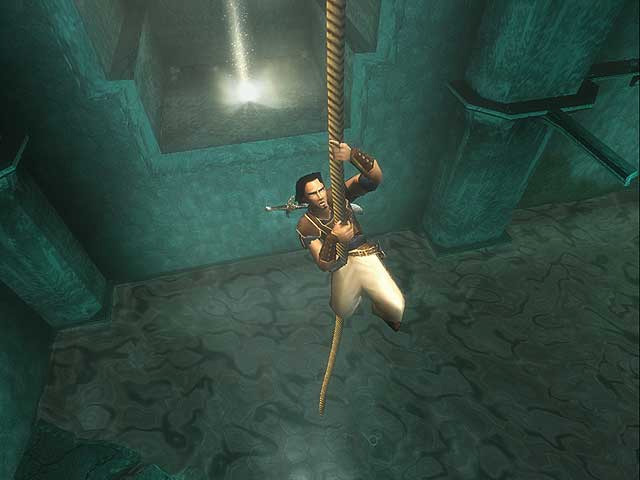 It's been a long time since I really enjoyed a platform game (besides the excellent Sands of Time, and possibly combat/puzzle/platformer God of War, if you're stretching.) I don't know if it's because platformers are easy to grow out of as you get older and want a more complex experience, or if it's a function of the waning of that particular genre as time's gone on. Maybe it's because I'm largely a PC gamer, and platformers have never been the PC's strongpoint. I think it may have something to do with the fact that as the graphical presentation of games has become more convincing, realistic, lifelike, the core gameplay of platformers has become less viable. Characters jumping 20 feet over chasms and up onto ledges doesn't really "read" when you've got hi-res, super-lifelike graphics onboard. And how do you set up an exciting, challenging platform level in a realistic setting? When I'm walking down the street, I don't tend to see a lot of floating planes or gaping holes I have to jump over. One exception seems to be the new Prince of Persia series, which has successfully matched its realistic-fanciful setting with a new and engaging approach to the 3D obstacle course, but that series is more the exception than the rule in this day and age. Maybe, as the possibilities of game experiences have grown and developed and broadened in every direction over the years, the traditional, very straightforward run-and-jump experience provided by the game designer as obstacle course administrator has fallen by the wayside. Maybe people just don't feel like jumping over hurdles anymore.
No comments:
Post a Comment
Note: Only a member of this blog may post a comment.